Month: July 2026

  • Artists in Residence Archives

    New Works Residency

    2018 Artists in Residence

    Harvestworks is pleased to announce the recipients of the 2018 New Works Residency. During their residencies, artists developed new projects in the Harvestworks TEAM Lab — Technology, Engineering, Art, and Music — with support from Harvestworks staff and technical consultants.

    The 2018 applications were reviewed by composer-performer and sound artist Christina Campanella, artist and DiMoDA director Alfredo Salazar-Caro, and artist/technical consultant Matthew Ostrowski.

    Program: New Works Residency

    Year: 2018

    Lab: Harvestworks TEAM Lab

    Beth Bradfish

    Beth Bradfish

    Untied | United

    Untied | United is a multi-speaker installation exploring memory, intimacy, and the unconscious textures of everyday life. Elastic threads stretched throughout the space trigger sounds when touched by visitors, creating an evolving soundscape that is both abstract and familiar.

    Beth Bradfish is a composer and sound artist whose work brings audiences into close, physical engagement with sound through chamber music, installations, and custom sound objects.

    Mark Cetilia

    Mark Cetilia

    Laws of Reflection

    Laws of Reflection investigates spatial audio through hyperdirectional speakers paired with pan-and-tilt controls. The system projects sound onto walls and objects, using architecture itself as a reflective surface for active listening.

    Mark Cetilia is a sound and media artist working between analog and digital technologies, generative systems, custom hardware, software, sound, and image.

    Lauren McCarthy

    Lauren McCarthy

    LAUREN

    LAUREN is an interactive performance in which McCarthy becomes a human Amazon Alexa, remotely watching over and controlling aspects of participants’ homes. The work examines automation, surveillance, intimacy, and the desire to reclaim agency within networked domestic life.

    Lauren McCarthy is an artist based in Los Angeles and Brooklyn whose work explores social and technological systems for being a person and relating to others.

    Amanda Gutiérrez

    Amanda Gutiérrez

    Walking on Lightness

    Amanda Gutiérrez will translate her film essay Walking on Lightness into a virtual reality environment based on soundwalks recorded in Sunset Park. The project considers embodiment, cultural access, memory, fear, and public space.

    Gutiérrez explores home, belonging, and cultural identity through sound, performance, and everyday practices that shape individual and collective experience.

    Morehshin Allahyari and Prince Harvey

    Morehshin Allahyari and Prince Harvey

    New collaborative work

    Morehshin Allahyari and Prince Harvey will develop a new body of work on immigration, memory, grand narrative, and future-building through what they call “micro-Afrofuturism” and “micro-Gulf-futurism.” The project brings together virtual time mapping, data visualization, experimental film, and alternative hip-hop.

    Allahyari’s work considers technology as a philosophical and poetic tool, while Harvey is a New York-based artist and musician known for alternative hip-hop and experimental approaches to production.

    Andrew Neumann

    Andrew Neumann

    Watching:Camera:Moves

    Watching:Camera:Moves is an immersive multi-channel video and audio installation that analyzes and reconstructs camera movement through cinematic and sonic space. Moving screens and projections deconstruct the frame and transform the wall into an active spatial composition.

    Andrew Neumann works across photography, video, sculpture, installation, and electronic music, often integrating digital and electronic technologies into sculptural forms.

    Jon-Carlos Evans

    Jon-Carlos Evans

    Dreampop/Dysphoria

    Dreampop/Dysphoria is an audiovisual album and immersive video performance that follows the downfall and awakening of dVA, a 21st-century AI pop star. The work merges digital art, music, cinema, performance, and anti-propaganda.

    Jon-Carlos Evans is a filmmaker, audiovisual artist, writer, and musician working under the alias Klaas von Karlos and through the audiovisual collective ReVerse Bullets.

    Efraín Rozas

    Efraín Rozas

    Myth and Prosthesis

    Myth and Prosthesis is a series of performances in which a drumming robot improvises polyrhythmic patterns in real time. The robot responds to site-specific rhythmic or cyclical events, from flags moving in the wind to microbial activity, using camera-tracking systems.

    Efraín Rozas is a Peruvian musician and researcher whose work focuses on software design, robotics, artificial intelligence, polyrhythm, and the cultural dimensions of technology.

    Julia Sinelnikova

    Julia Sinelnikova

    Persons of Interest

    Persons of Interest is an interactive video installation exploring otherness within the American sociopolitical landscape. Using surveillance feeds, webcam images, video portraits, translucent projection surfaces, and ambient sound, the work creates a projection-mapped environment around visibility and power.

    Julia Sinelnikova is an interdisciplinary artist working with holograms, performance, digital culture, electronic music, and sculptural environments.

    Jakob Steensen

    Jakob Steensen

    Re-animated Archives

    Re-animated Archives explores virtual natural history collections of recently extinct species and how archives shape future ecological imagination. At Harvestworks, Steensen will develop spatial audio workflows for VR, including ray-traced sound that can bounce, occlude, and respond to virtual landscapes.

    Jakob Kudsk Steensen is a Danish artist and art director based in New York whose work brings together virtual ecosystems, 3D environments, sound, and ecological research.

    Amy Youngs

    Amy Youngs

    Becoming Biodiversity

    Becoming Biodiversity is an augmented reality artwork that invites participants to encounter ecological, indigenous, and local networks within an urban park. Using phones and headphones, the work overlays mixed-reality animations and storytelling onto public space.

    Amy Youngs creates biological art, interactive sculpture, and digital media that explore interdependence between technology, plants, animals, and non-human systems.

    Eva von Schweinitz

    Eva von Schweinitz

    The Space Between the Letters

    The Space Between the Letters is a multidisciplinary, research-based performance project about adult literacy, learning, and the politics of education in the United States. The work integrates interviews, interactive video, sound design, live drawing, and choreography.

    Eva von Schweinitz is a German-American interdisciplinary artist based in Brooklyn who creates original research-based work in collaborative settings.

    John Kelly

    John Kelly

    Underneath The Skin

    Underneath The Skin is a multimedia dance theatre work based on the life and work of Samuel Steward, a closeted queer scholar, tattoo artist, diarist, novelist, and writer of erotic fiction. The performance incorporates multi-channel video, animation, and rendered text.

    John Kelly is a performance and visual artist whose character-driven works examine survival, public and personal struggle, social outsiders, and creative genius.

    Kyle deCamp

    Kyle deCamp

    New multimedia installation/performance

    Kyle deCamp will produce a multimedia installation and performance exploring the movement of light, bodies, and images through architecture. The project was sparked by the demolition of Goldwater Memorial Hospital on Roosevelt Island, designed by Isadore Rosenfield, deCamp’s grandfather.

    Kyle deCamp is an interdisciplinary artist working across media, architecture, theater, performance, choreography, history, and spatial experience.

    Qubit

    Qubit

    Residency projects

    Qubit is a collective of composers and sound artists presenting innovative applications of technology in music. At Harvestworks, the collective will use the audio recording studio and public presentation programs to develop projects by David Bird, Alec Hall, and Bryan Jacobs.

    Their projects include music theatre works for TAK Ensemble and Subwhistle, a sound installation that uses low-frequency audio signals to physically activate slide whistles.

    Scholarships

    Danny Bracken

    Danny Bracken

    A Stillness in the Dark

    A Stillness in the Dark is a subtly interactive installation using multi-channel sound and electroluminescent wire. Built with Max/MSP and a microcontroller, the work responds to movement in the space and resumes when stillness returns.

    Danny Bracken’s practice explores technological change and its effect on how we perceive the people and places around us.

    Stephanie Gray

    Stephanie Gray

    Do You Know What A Magician Is?

    Do You Know What A Magician Is? is a film-video work about communication and hearing from the perspective of hearing loss. Through found and original footage with sonic experimentation, the work immerses viewers in altered modes of listening.

    Xiameng Summer Lin

    Xiameng (Summer) Lin

    New interactive installation

    Inspired by the Italian Pavilion at Caramoor in Katonah, New York, Lin will create an interactive installation and multichannel composition that recreates the pavilion’s unusual acoustic effect, where sounds appear to accumulate and “freeze” within its boundaries.

    Daniel Neumann

    Daniel Neumann

    CHANNELS.applied

    CHANNELS.applied extends Neumann’s continual composition project into new architectural spaces and performance systems. At Harvestworks, he will expand the original patch into a more flexible architecture for future installations and performances.

    Daniel Neumann is a Brooklyn-based sound artist, organizer, and audio engineer whose work focuses on how sound interacts with and shapes space.

    Simona Prives in collaboration with Ross Williams

    Simona Prives in collaboration with Ross Williams

    We Said We Didn’t See It Coming

    We Said We Didn’t See It Coming is an immersive interactive installation examining the relationship between the organic and the man-made. Life-sized projections, musical compositions, animation, and audience movement create a multi-sensory environment shaped by time, place, and fragmented memory.

    Simona Prives creates physical and digital collages, animations, prints, and drawings through processes of decomposition and reconstruction.

    Workspace Residents

    Laura Splan

    Laura Splan

    Material Expressions

    Material Expressions is a series of kinetic sculptures activated by biosensors. Using electromyography electrodes, a performer’s muscle activity controls motorized sculptural elements made from found materials, handcrafted components, and 3D-printed forms.

    Laura Splan’s work explores intersections of art, science, technology, craft, and the body, often combining textiles with technology to question agency, chance, and material embodiment.

    Andrea DeFelice

    Andrea DeFelice

    Lemon Bomb Face

    Lemon Bomb Face is part of a series of mechanized light paintings in which words are hidden and revealed through ultraviolet and daylight. The works combine wood, steel, UV pigment, Arduino, linear motion mechanisms, and custom components.

    Andrea DeFelice works across video, drawing, algorithmic art, sculpture, engineering, and mechanical hacks to investigate technology, human behavior, and how information is received.

    Tali Hinkis

    Tali Hinkis

    Fremd Comfort Zone

    Fremd Comfort Zone is a wearable and spatial technology environment for immersive audiovisual performance. Combining textile design, biosensors, and embedded spatial sensors, the work deepens connections between performers, instruments, space, and audience.

    The project continues LoVid’s practice of combining handmade audio/video instruments, wearable technology, and visceral video performance.

    Brian McCorkle

    Brian McCorkle

    11 Attempted Decompositions

    11 Attempted Decompositions treats composition as a process of reversal: a series of musical decisions rather than a predetermined melody or harmony. Across recording sessions with more than 50 artists, the project explores light, timbre, loudness, note, meaning, contact, conversation, periodicity, presence, and absence.

    Brian McCorkle is a composer, performer, digital artist, and Co-Director of Panoply Performance Laboratory with Esther Neff.

    Catherine McCurry

    Catherine McCurry

    That Time When

    That Time When is a mixed-reality narrative that maps a VR experience onto a physical installation. Combining neuroscience, physicality, sound, and comedy, the work invites participants to move through the memories of an unnamed research subject.

    Catherine McCurry is an artist, musician, and creative technologist based in Brooklyn whose work uses technology to create new paradigms for interactive and participatory storytelling.
  • STARS #01

    From this month’s theme, “Memory”, here are 4 recordings and works from artist in the greater New York City experimental scene that we encourage you to experience…

    Harvestworks’ 2026 Artist in Residence – Justin Allen

    An early performance of an active project. Allen performed with voice and tap dance. The project explains itself, recalls old technology for Karaoke, and gives it a broader purpose. Allen sings a melody, backed only by silence and the occasional tap from his shoe. The melody gets locked into your brain through repetition. The project resembles both a game and a psychological experiment. Keep listening; the project is still in the works, and will resurface soon.

    Recording provided by e-flux. Captured at the 2026 “50 years of Harvestworks” celebration event

    Moving Through at Sinkhole Press Gallery

    At Sinkhole Gallery in Ridgewood, Queens, the threads of Harvestworks untangle further. Curated by Alek Greene, Moving Through presents works from eight artists as they use technology as a figurative methodology of reflecting human emotion. Faulty risograph prints, sprawling text, and abundant imagery fill the small white room at Sinkhole. I recently visited the space guided by Greene and Miguel Gallego, one of the artists on display. I saw the rumblings of the Harvestworks mission as the pieces all use technology as an interrogative tool instead of a flat innovation.

    Video captured and edited by Stephanie Farmer

    Filling the Shell – Performance made by Yi-Han ( Audrey ) Chou

    A work-in-progress performance exploring fragmented memory, inherited emotion, and embodied history through choreography, responsive technology, sound, and visuals. This presentation is the third installation of the project as part of RE/VENUE X Mabou Mines Festival. It’s a coordinating conjunction that makes two or more things possible at once, bringing binaries, genres, disciplines, and forms into proximity. In this installment, performers, systems, and environments shape one another, inviting audiences into an evolving ecosystem as forces of change to the narrative.

    Directed by Yi-Han ( Audrey ) Chou produced by ARESPHERE partnering with BODYSONNET

    Singh – Audio soundscape by Saher Prakash

    Saher describes this piece as a collection of field recordings of natural sounds, including peacocks in Portugal, genuine laughter, and arbitrary human conversation. Most of the audio is intentionally raw and minimally altered. It evolves into a lyrical portion that encapsulates the main messages of the piece – a desire not to think so much about the things she creates. Just connect with roots.

    “Singh” is a common last name of the Indian diaspora and the last name of one of Saher’s best friends who’s laughter inspired this piece. It’s homophonous with the verb “sing”

    Edited by Saher Prakash


    Further resources!

    Explore the names mentioned in this feature….
    Justin Allen, e-flux, Alek Greene, Saher Prakash

  • Issue #1

    Issue #1

    Dear reader,

    The theme of FIELDWORKS’ inaugural issue is “Memory,” inviting you to connect with community through nostalgia and storytelling. We’ll explore how memory manifests through oral histories, evolving technology, and humanity’s enduring legacy of art in the little things.

    Art is a form of memory just as much as it is a form of expression. Our journalists’ discussions with figures like Brenda Hutchinson and Greg Kramer in this issue, exemplify the fluid and timeless art community that occurs inside and around Harvestworks.

    We’re so happy that FIELDWORKS is finally yours as of Friday August 7th, 2026. There’s so much for us to discover together, so welcome to our world.

    With love,
    Editors Saher, Stephanie, and Ganling

    Choose your path to uncover Issue 1 below!

  • The Woman Who Lived at Harvestworks

    Listen to the full story created from interview recordings with artist Brenda Hutchinson

    00:00.00

    Timestamps

    (00:58) The Woman Who Lived at Harvestworks

    (04:40) Artistic Style

    (07:06) Joan Jonas

    (10:00) Liquid Sky

    (13:20) The Daily Bell

    Read the story

    Full Story Transcript

    Introduction & The E-flux Event

    Saher Prakash: The walls of Harvestworks have held a lot of memories.

    (Audio transitions)

    Saher Prakash: And this year, 2026, we're celebrating 50 years of Harvestworks, having served 661 artist-in-residence and counting. We celebrated this milestone this year with an event, in collaboration with our partners, E-flux.

    Ivana Dama: Harvestworks means a lot to a lot of people and I feel very fortunate to experience that myself, both as an artist, and now being in a kind of position to be able to help a larger community.

    Saher Prakash: That's Harvestworks interim director Ivana Dama, and she gave a beautiful speech at the E-flux event. She told one particularly interesting story, about a woman named Brenda Hutchinson.

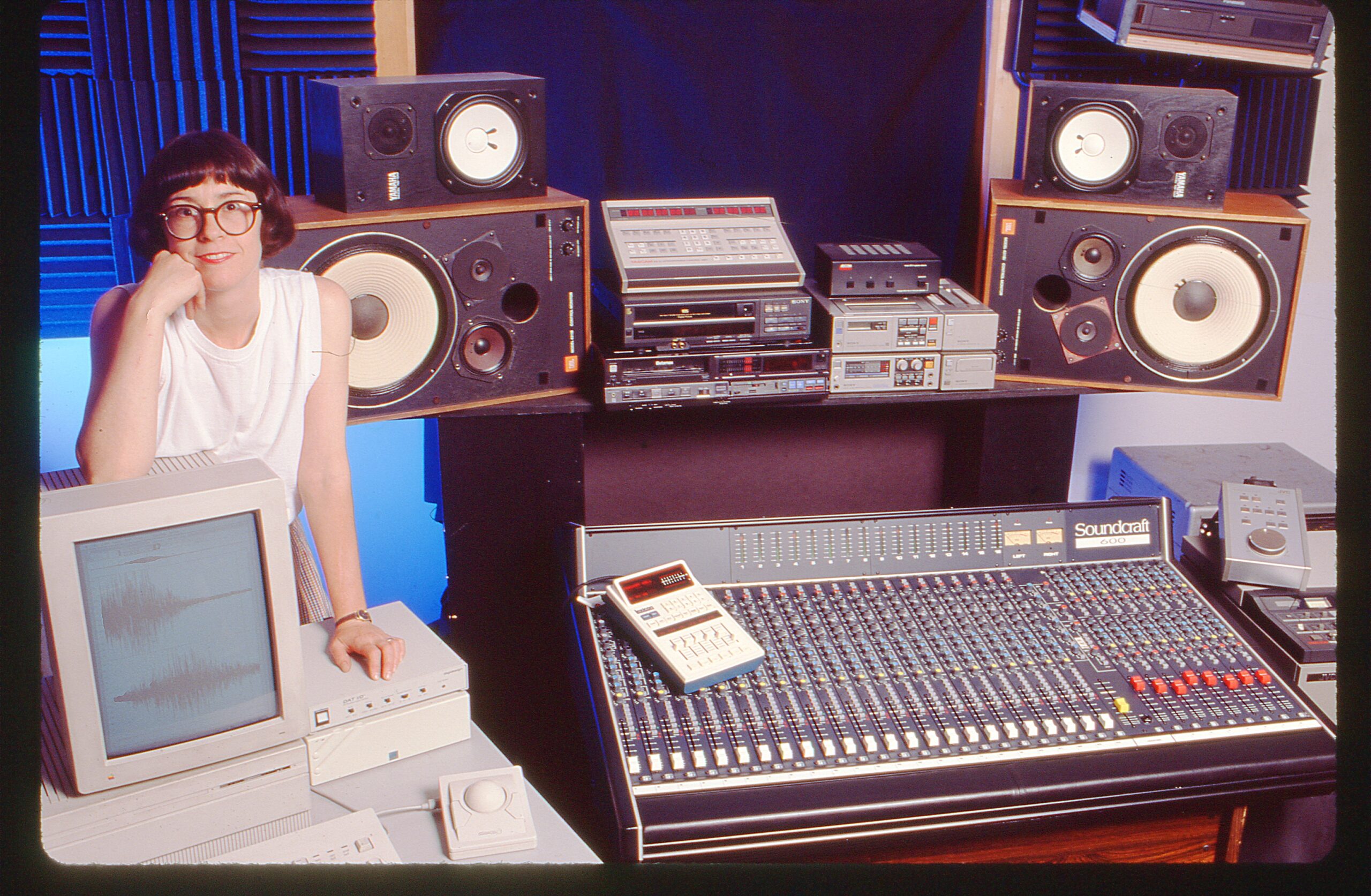
    Ivana Dama: But one fun fact is that Brenda lived at Harvestworks, so she described this as like "chic homelessness," and she said that she would shower across the street—I don't know how much I should talk about that. But she was there for 24 hours, and that was quite incredible that artists can come to Harvestworks in the middle of the night and Brenda can make recordings for you, for $4 an hour.

    Saher Prakash: We found it incredible that for a time there was someone literally living at Harvestworks. By we, I mean the editors at Fieldworks. Hi, I'm Saher Prakash, and later in the episode, you're going to hear from my co-editor Stephanie Farmer. Anyway, after hearing that story, we decided we had to ask Brenda for an interview.

    Stephanie Farmer: Well, hello Brenda.

    Brenda Hutchinson: Hello Stephanie.

    Finding a Home at Harvestworks

    Saher Prakash: As Stephanie discovers in this interview, Brenda's story is one of serendipity and exploration, representing the ecosystem of the life force of Harvestworks. And she became part of the organization for the same reasons that many other artists have: for the accessibility.

    Brenda Hutchinson: And so I had a lot, a lot of cassettes. And so that's when I came to Jerry and I said, how much can I have on the—I wanted to transfer everything over to the Revox and edit it. And he said, "Okay," he said, "five months, Monday through Friday, four hours a day, for $300."

    Saher Prakash: It was a place for real people, like Brenda, to hold real technology in their hands. And it's not just a studio, it's a community. Brenda's warmth and the warmth of the place in which she resided comes through in these interview recordings.

    Brenda Hutchinson: The back of my head at the Revox machine with headphones on, that's how—that's my introduction to most people. I just stay, I eventually I just stay there. I was there, you know, on Mondays, so I moved into that little back room there.

    Saher Prakash: She indicates towards what's essentially a shelf in a photo of the old Harvestworks studio. And it was all she needed, so she slept there.

    Brenda Hutchinson: ...equipment and stuff. So I just moved it around and I slept up there and Carol had a little desk looking out the window, and that was her office.

    Saher Prakash: She taught there.

    Brenda Hutchinson: ...and I taught the Fairlight class and if people needed to come...

    Saher Prakash: And she was always available.

    Brenda Hutchinson: Laurie Spiegel, I remember one time 2 o'clock in the morning she had her time, she came in, she woke me up if she had a question, I'd like climb down the ladder, I'd go over, help her out, and then go back to bed. So that's how I eventually, you know... That was really—I lived at Harvestworks. I didn't just work there. I was really... lucky me.

    Philosophy of Access and Early Artworks

    Saher Prakash: It quickly became clear how much Brenda reflected the art world that she was a part of. It's a malleable and ever-changing world and in turn, so was she.

    Brenda Hutchinson: I knew how to work everything pretty, you know, and as stuff would come in, and as technology would change, I would have to change. I had to learn.

    Saher Prakash: We want to take you into this world that she nurtured for herself and for the people around her. Brenda's life is very interesting and spontaneous and rich, but what we really want to look into is what her story represents for Harvestworks, and art more generally.

    Brenda Hutchinson: It was putting sophisticated tools into the hands of, you know, people who had—individuals who had really important and interesting things to say. And it was part—and there, and we're all part of this really vibrant community. And so that, you know, I mean everybody knew everybody.

    Saher Prakash: Brenda benefited greatly from Harvestworks, but still, as an artist in New York, and especially as a female in a male-dominated field, she found herself often under-resourced, a sentiment that most creatives can relate to. But Brenda had what we believe to be a particularly important philosophy behind her artistic process.

    Brenda Hutchinson: It was like IRCAM, Stanford, and MIT were the three places then that had that amount of computing power. And they were not exactly hospitable toward women. So I figured, okay, I could spend my life, you know, banging on these doors to get access to these things, or I could, I thought, okay, well what do I have access to? And it's like, well, I have access to my life.

    Saher Prakash: Since Brenda wasn't interested in chasing expensive technology or elite institutions, she had to make art from the one thing she already possessed: her own life.

    Brenda Hutchinson: ...of my work was I was gonna document my life, however it was going along in whatever form I could, and that to sort of find ways to connect with people through that.

    Saher Prakash: And truly, her work is just a saga of her connecting with people in different ways. Sometimes it's really easy and obvious, and other times it's really difficult and unexpected. Either way, it was economical, and it always ended up being profound. Like in her piece Every Dream Has Its Number, where she recorded her mother's story against her own and dissected her upbringing. It sounds like this:

    Brenda Hutchinson (Audio Clip): I don't know how you think I could've had a gambling problem on $3 a week... What do you mean by gambling problem? When I played poker for pennies? We have a lottery here in Arizona, and I play every week... You can't call when I went to Liberty Bell a gambling problem, I said because I won a lot of money.

    Saher Prakash: Or there's her piece called Storytime, which is exactly what the title makes it seem. This is what the beginning sounds like:

    Brenda Hutchinson (Audio Clip): First a song. It's not an original song, it's a song from a Saturday morning cartoon show in the late 50s and the early 60s called Cartoon Corners General Store. And the host of the show was Gene London and he used to sing this song, which was called "Let's Pretend That It's Storytime." Let's pretend that it's story time...

    Saher Prakash: There's a true sentimentality and personalness to the work that Brenda does, whether it's sonic, visual, technological, or whatever else it could be. Really, the adjective is a humanness that resounds in her work. The humanness which it's our job at Fieldworks to convey. Now, Stephanie's going to take over and dive deeper into some of Brenda's work and one of her especially impactful current projects.

    Collaborations and the Liquid Sky Era

    Stephanie Farmer: At the E-flux event, we were really strongly introduced to Brenda's work by watching the film Volcano Saga by Joan Jonas, which was created in 1989. The publication excerpt from the MoMA's highlights since 1980 claims that Volcano Saga was originally performed live on stage narrating an Icelandic folktale about a woman and her adventures revolving around four mysterious dreams. Jonas then translated this performance into a video. This video came across Brenda's desk, and she tells us the sort of magical, whimsical story of meeting Joan Jonas and her coming into the studio at Harvestworks.

    Brenda Hutchinson: She had already booked an appointment to work on this film. And so, and I, you know, I was the person. So, and when she came in she was all wet, her hair was wet, and she was, you know, not happy. So I imagined that she had walked over from the Village somehow. And also because she said that somebody had—what happened was somebody had opened up a window and threw a pot of water—a pot of water out, just, and it landed on her. And she, she just kept coming, she just came over, and you know, because she had this appointment and it, and you know, that was important. This is how it was an important thing, right? Everybody's like, "Gosh you're able to do your work," and he's like, "Who's gonna miss that opportunity?" And so she came, and we worked on the piece, and I don't, I don't remember some of the video, and I just remember how beautiful it was. And how, you know, once we were working you're in that world.

    Stephanie Farmer: Joan Jonas's presence in the studio, and her willingness to come despite being soaking wet, really captures how valuable time at Harvestworks was, and how affordable it was, and how much it meant for people to be in this space. This incredible story didn't get in her way of coming and producing this film. There was an ecosystem of accessibility, and it was always accessible to Brenda because she was always there, because she lived there. And she really fostered and participated in this culture of artists being connected to technology to be able to tell their stories.

    Brenda Hutchinson: Not just, uh, you know, plugging stuff in and doing things. But there was a lot of collaborating going on, you know what I mean? And I had absolutely no influence on whatever she was doing, but I just tried to help whatever I could do that she needed. If I could do it, I would like say, "Hey, well how about, how about this?" or "Sound-wise" or "Mixing-wise" or "Whatever." So that's, that was my relationship with her, and I do remember that piece, and I remember of course really liking her. I mean, she came in there all... somebody dumped a pot of water on her head!

    Stephanie Farmer: Brenda's constant presence in the studio also led her to work on this incredible project, the film Liquid Sky released in 1982.

    Brenda Hutchinson: I'll tell you I could tell you about that Liquid Sky. So because I was living there, people would make appointments all day and night. So at 11 o'clock at night this guy Slava Tsukerman and Nina Kerova, they had an appointment. And there had been a blizzard that day, and so a lot of the day no one—people canceled, canceled, canceled, canceled. 11 o'clock at night, they walk in and there and I'm like, "Oh wow, you, wow, I'm, you know, surprised you made it." And he's like, "We are from Siberia." And you know, and they're all bundled up and everything and it's like a little snow is not going to stop them.

    Stephanie Farmer: Brenda had unique access to tech as it passed through the studio. Most notably, the Fairlight Computer Musical Instrument, a digital synthesizer, sampler, and audio workstation. She was invited to study the Fairlight in California and returned to New York to teach classes for the instrument alongside composer Clive Smith. An actor from Liquid Sky took one of these courses.

    Brenda Hutchinson: And so he must've told Slava about this instrument. They sent me over to this, um, place in the West Village to watch the film. And when it was on 11 little reels, just unedited, just there was something so powerful about it and beautiful, and I thought, "Oh yeah, I want to work on this." So I got, I got $2,000 for doing that whole score. But it was a life changer, when I realized that it was an international release. Now here I here I am living in the, you know, on the shelf in the... you know, that, um, what an impact, what an amazing reach.

    Stephanie Farmer: Not only did Brenda contribute and support these other artists as they came through the studio with their studio pass appointments, she also dedicated a lot of her time to developing her own artistic voice and working on her own practice. Some of her independent work was featured in Tellus, the audio cassette magazine. Tellus is a program of Harvestworks with the idea of a magazine on cassette which would feature interesting and challenging sound work. With the advent of the Walkman and the boombox, these editors perceived a need for an alternative to radio programming and the commercially available recordings on the market at the time. During our conversation, I played for Brenda one of her pieces which was featured in the very first issue of Tellus. This piece is called Wordplay.

    (Audio Clip of Wordplay)Voices: Strange... strange... strange... strange...

    Stephanie Farmer: Brenda giggled while we played this piece for her, the feeling of tapping the keys on the Fairlight really coming back to her, and she then explained that sort of tactile memory of playing this innovative instrument to create this abstracted sound.

    Brenda Hutchinson: But it's interesting when you know that it's all done with a keyboard, 'cause you can hear it go brrrp, like this. That was all, that was all people in the movie.

    The Daily Bell Project & Community Ritual

    Stephanie Farmer: After talking about her long history at Harvestworks, we followed the rest of her story, and we caught up with her in the present day. Currently, Brenda is working on this project, the Daily Bell. A ritual of community that isn't just another project, it's a culmination of her entire philosophy. Brenda's work was always about attention, listening, gathering people, making meaning from ordinary life.

    Brenda Hutchinson: It started in 2008. And I think I mentioned this the other day, it's like, for me, it was a, like I call this like a "treading water project" because it's like, you know, I just I just had to do something to keep working.

    Stephanie Farmer: What began with a cross-country drive ringing a 250-pound bell to see how the public would respond has become a ritual of ringing this large bell, or whatever smaller one she carries on the go, at sunrise and sunset, to remind people that for that very moment, something indisputable is happening: the rising or setting of the sun.

    Brenda Hutchinson: If you think at that moment that you are witnessing the sunrise or sunset and you bring to mind that this is in fact happening to every other living thing on the planet—I mean and people especially—then think about that at that moment, you can connect with everybody in a way. And that there's so few opportunities for people to do that. And so all what it requires is that you you stop what you're doing, and you, and for me it's like the bell, I'm not a, I don't really care about bells, but it's like, when you ring a bell it carries. A little bell, a big bell. So they can be used for as signals for, and warnings, and it's a communal thing, a way to communicate that people can hear. Sometimes they could translate what that bell meant. So it's a way to just be, another way to be with people. So this is the 19th year now that I've been doing that. And you know, it's, it's like practicing an instrument. You've developed some kind of little muscle for something.

    Stephanie Farmer: I was so inspired by the ritual of the bell that I decided to join in Harvestworks' New York City celebration of the 2026 Summer Solstice. Some friends and I trekked on the Dumbo Ferry to gather with a community of others who were eager to live in the moment as well. Wind in our hair, and bells dispersed to the entire upper deck of the small boat, we rang in the new season together. Surrounded by that very present community, I started to understand the personal and emotional impact that this ritual had on Brenda's life, and she told us in our conversation a little bit about the dark times that this ritual has given her the strength to get through.

    Brenda Hutchinson: You know, so like this last year my husband was like suddenly diagnosed with like total metastatic cancer in February. And so he decided not to be treated because there was no point. And so we spent the next eight months at home in hospice. The bell thing made it—I learned a lot, it was like the whole, I don't know, it's like how I paid attention to like Norman dying. It was like as soon as he decided dadada, it's like, "Okay, on it." And I feel like all those years of doing this, just you stop what you're doing... stopping what I was, whatever is the most important thing at the moment it becomes evident and you, you kind of get a clarity about it. And so paying attention to whatever that is—now this that was a big, that was a big thing. But it was like, it, it just I felt like I've been training for it all my life.

    Stephanie Farmer: This is the sound of the bells from Brenda's 2026 Solstice Daily Bell Celebration.

    (Audio clip of bells chiming over soft chatter)

    Conclusion

    Stephanie Farmer: The soft chatter and the subtle celebration of life through sound exemplifies exactly why we knew Brenda's story belonged in the first issue of Fieldworks. With memory as the theme of issue one, it felt fitting to experience memory through the stories we tell and the voices that carry them forward. As a producer of oral histories, Brenda reminds us that memory lives in sharing.

    It's remarkable that she was able to literally call Harvestworks home, a place where despite its humble walls, she contributed to international releases and community projects that connected people across neighborhoods, states, and beyond. That's the spirit of Harvestworks. A place where innovation begins with curiosity, and community, and care. We hope everybody who walks through its doors feels as welcome to explore as Brenda did.

    So, with that, welcome to Harvestworks. And welcome to Fieldworks.

    Credits

    Produced by Saher Prakash, Stephanie Farmer, and Ganling Zhou
    Audio edited by Ganling Zhou and Saher Prakash
    Narration by Saher Prakash and Stephanie Farmer


    Further resources!

    Explore the names mentioned in this feature....
    Joan Jonas, Slava Tsukerman, Nina Kerova, Laurie Spiegel