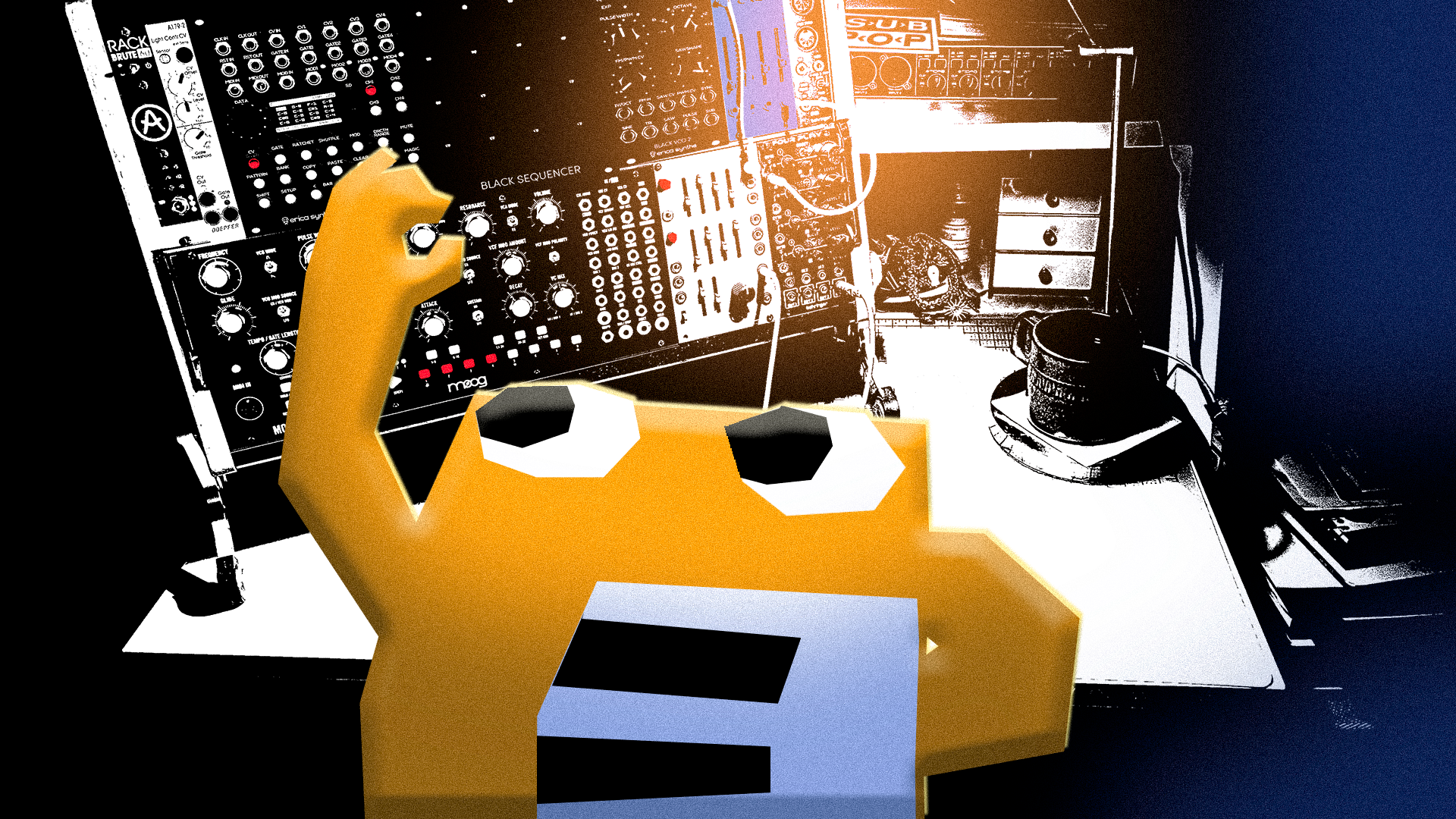
Cover art by Vesta Weed, from animated series “Morg and Snorf” — @horsedrawn on Instagram
Greg Kramer remembers when the future was weird, expensive, and full of synthesizers.
WRITTEN BY SAHER PRAKASH
As a creator of music and media in New York City, I am no stranger to the vintage technology boom amongst young media makers.
In 2026, “old” technologies are romanticized, existing in their own market of artistry and nostalgia. Instagram is flooded with photos from point-and-shoot digital cameras and music videos are tinted with the undercooked quality of a camcorder. I watch my peers purchasing Walkman-style foam headphones, shooting on MiniDV, recording onto cassette, and hunting down synthesizers that were manufactured before they were born.
Music producers and engineers are in a race to stock their studios with analog equipment like their career depends on it — and maybe it does. Even the photographers and videographers flock to the dingy, in pursuit of nostalgia. Oftentimes, the “worse” the image looks, the more human it feels. A classmate of mine recorded their whole music video on a Nintendo DS, which is so unnecessary and so beautiful.
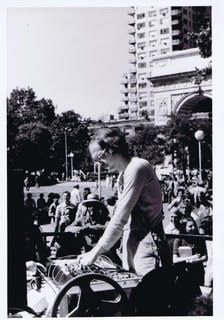
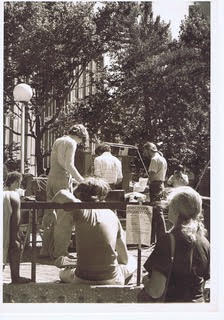

Image from Vintage Synth Explorer
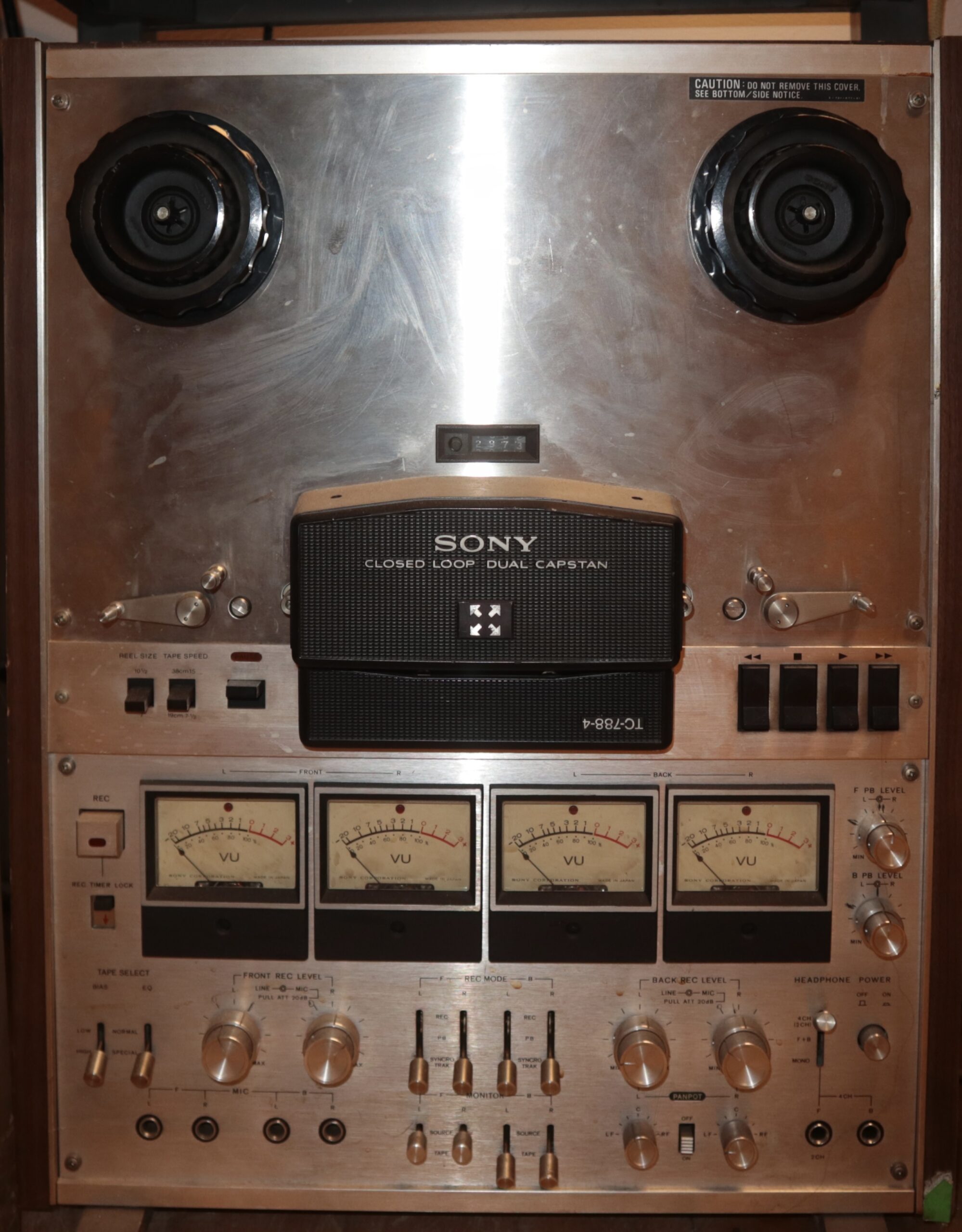
Technology nostalgia is painted into pop culture as seen in the song “OLD TECHNOLOGY” from breakout electronic hyperpop vocalist Slayyyter. The song, off her recent album WOR$T GIRL IN AMERICA, is explicitly an ode to bygone technologies, leaning into gritty electronic sounds and a grungy glamorization of items like her iPod. Such romanticization is funny, as its most common perpetrators didn’t necessarily experience these technologies as the futuristic new inventions they once were. What was once the future is now a prop for remembering the past.
If I had to guess, Slayyyter is not nostalgic for the technology’s original function, but rather for its limitation — a feature that often begets invention. Old audio technology is interesting not simply because it sounds old, but because constraints make choices visible.
In an age where technology advances every day, putting every choice in front of us, it’s not surprising to me that we yearn for some limitation — something that will reliably set boundaries.
One thing we can count on is, as technologies develop, their ever-changing features imprint themselves as qualities of the eras they were born in, almost like a sensory timestamp. This is the case with any evolving form of expression. Poodle skirts represent early 1950s American teens just as the Minimoog Model D represents the moment in the 70s when synthesizers and their unfamiliar electronic vocabulary became culturally legible, obviously…
Just kidding! Here’s some history >>>
Synthesizers changed the way we make music by generating sound electronically rather than relying on an existing instrument. They could mimic familiar sounds, distort them, or create something entirely new.
In the 1960s and 70s, systems like the Moog Modular and Buchla 100 were being developed and were still unfamiliar, expensive machines. As they became more accessible, experimental musicians and artists began figuring out what these machines could actually do.
And that’s the important part: there was no “synthesizer sound” yet. There was no established vocabulary telling artists what these machines were supposed to sound like. They were turning knobs, patching cables, and figuring it out as they went.
Before the synthesizer became shorthand for the sound of the 1970s, it was simply a strange new instrument with almost no rules…
But for real, there are distinct analog sounds that developed in the 70s that modern electronic artists cling to with primal strength. Whether it was ABBA’s textured pads or The Buggles’ distant electronic drums in 1979’s “Video Killed the Radio Star“, these sounds mean a lot to creatives today.
But before analog synthesis became a coveted aesthetic, artists and engineers were figuring out what these machines could even do. Their sounds had no established vocabulary, their performances had no established audience, and their cultural meaning had not yet been decided. So I find myself exploring these old technologies with some lingering questions…
What did synthesizer work sound like as its revolutionary era was being constructed? What did it feel like for the artists making work that had no established audience?
Few people can answer these questions more directly than Greg Kramer — co-founder of Harvestworks and lifelong experimental sound artist. I had the pleasure of sitting down with him for an interview where we discussed his array of formative experiences within the experimental sound art niche.
When I asked Greg about his origins, he started by sharing the kismet story of how he acquired some tools that became essential for his career to unfold as it did — the time he happened upon a jackpot.
GREG KRAMER: I had a small company — I guess sounds makes it sound very official, but — where I was — I had purchased a lot of synthesizer inventory, Buchla inventory, when CBS Musical Instruments, which had taken over the 100 series, the first Buchla designs, and and found that they really couldn’t sell them. They didn’t know what to do with them. They were going obsolete, so they just put it on a shelf. I heard about it, and they ended up selling it to me for very, very, very little money. And I moved a lot of that stuff out to the East Coast when I moved to the East Coast, and so I was selling some modules and stuff to colleges or a few independent composers. But I was I–I went there just to buy one for myself as a musician because these were very expensive machines, at least by my standards, and I heard that they were, you know, that I might leave there with a synthesizer for a few $1,000, as opposed to 510, $1,000, you know. And I was scoring films, I was doing music for dance stuff like that, and I graduated Cal Arts, and it’s like okay. So I didn’t had no intention of going into business, but then when we saw this stuff, and I was with someone who owns business, and said, “Look, they CBS Musical Instruments doesn’t know what to do with this stuff. Offer them this much for the whole thing, and they’ll be glad to get rid of it. And he was right, and I was shocked. I was almost embarrassed to make. I was embarrassed to make the offer. So, so I had no intention of going into business, and there I was, and I didn’t know anything about electronics either. I was just a musician.
Greg’s lucky acquisition of a large collection of Buchla synthesizers gave him the unique opportunity to repurpose them for anything. This led him to forge one of the most communally pronounced accomplishments of his career: StudioPASS. As the keystone program in Harvestworks’ rise, StudioPASS gave NYC artists like Greg the chance to freely explore expensive equipment at uniquely low rates. Starting as just “PASS” in Greg’s Tribeca apartment, the program eventually added studio to both its name and physical space. Avant-garde artists passed through for these unique resources, creating a communal space for experimentation. Greg’s lucky encounter with CBS, in collaboration with young upstart Gerald Lindahl, cultivated the longstanding resource that StudioPASS became.
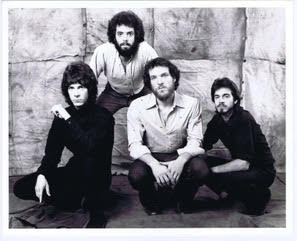

Moving forward with such creative liberty, Greg went on to lead one of the only touring live-only electronic ensembles of the time, called Electronic Musicmobile, which later became Electronic Art Ensemble. Firsthand, he experienced the small crowds, obscure venues, and confused faces that came with sharing experimental analog music. Hilariously, it would even upset onlookers at times. In my conversation with Greg, he painted the picture of what it was like to be an “altruistic, young, avant-garde musician” in the greater New York area in the 60s and 70s.
Many artists were involved with Greg’s avant-garde touring escapades, including Suzanne Ciani, Richard Teitlebaum, George Lewis, Marc Battier, Bob Ostertag, and of course Gerald Lindahl.

GREG KRAMER: Yes, there could be some serious like what is going on here coming from the audience, or even playing in Central Park, so-called sophisticated Central Park. It was like you make noise music in Central Park. Some people are very unhappy about it. News commentators come and cover it, and they’re snarky. You know nothing new there, right? So
SAHER PRAKASH: Right
GREG KRAMER: and like I remember performing in Co-op City in the Bronx, and like the main feature was that there wasn’t enough power coming out of the light pole, and my watch was stolen from my van, and like literally no one was at the concert. We were playing was like 100 degrees in South Bronx at this housing project, and we were there alone, making weird noises. I mean that’s how it was sometimes. We were all really dedicated. We were altruistic young avant-garde musicians, you know, and then we did connect more with people. There, of course, there were still plenty of places where audiences were tiny, or but more significantly, and you talked about connecting with the audience. There were places where you could feel the electricity. You could feel the the the wholeness, the excitement, the musicality, the sense of innovation succeeding-not just innovation sort of being thrown at people here, take it or leave it, folks. It was like, oh yeah, yeah, kind of feeling.
SAHER PRAKASH: What were those places? What did they feel like?
GREG KRAMER: The good ones, you mean?
SAHER PRAKASH: Yeah.
GREG KRAMER: Yeah, yeah. Well, three come to mind, I suppose, right now. One was in Buffalo, and we played at a place called Media Something. Anyway, it was a loft, and I mean, you know, the the story of it was like it was a you know a van full of really filled with all our gear, our whole sound system, and everything, and four guys, two in the front seat and two sitting on the equipment in back, and driving all this way. So the human story was also something. And then parking my van and having it broken into in in this bad neighborhood of Buffalo, but then the performance itself was bizarre and kind of ecstatic. Bizarre because there were literally about as many people in the audience, like four or five, and there were four of us in the group on stage. I mean, it was tiny audience in a large hall, so that was bizarre. But you know, we were of a nature to. We were just so sincere about our music that we just played as as well as we could, and we played brilliantly for this little tiny tiny group of four or five people. One of them was a reviewer, and gave us this astonishingly beautiful, well-written review. You know, they were both jovian and jovial and stuff like that. I mean, really strong, beautiful language. And he heard us. He it wasn’t just that it was he wasn’t bsing. He he got what we were doing.
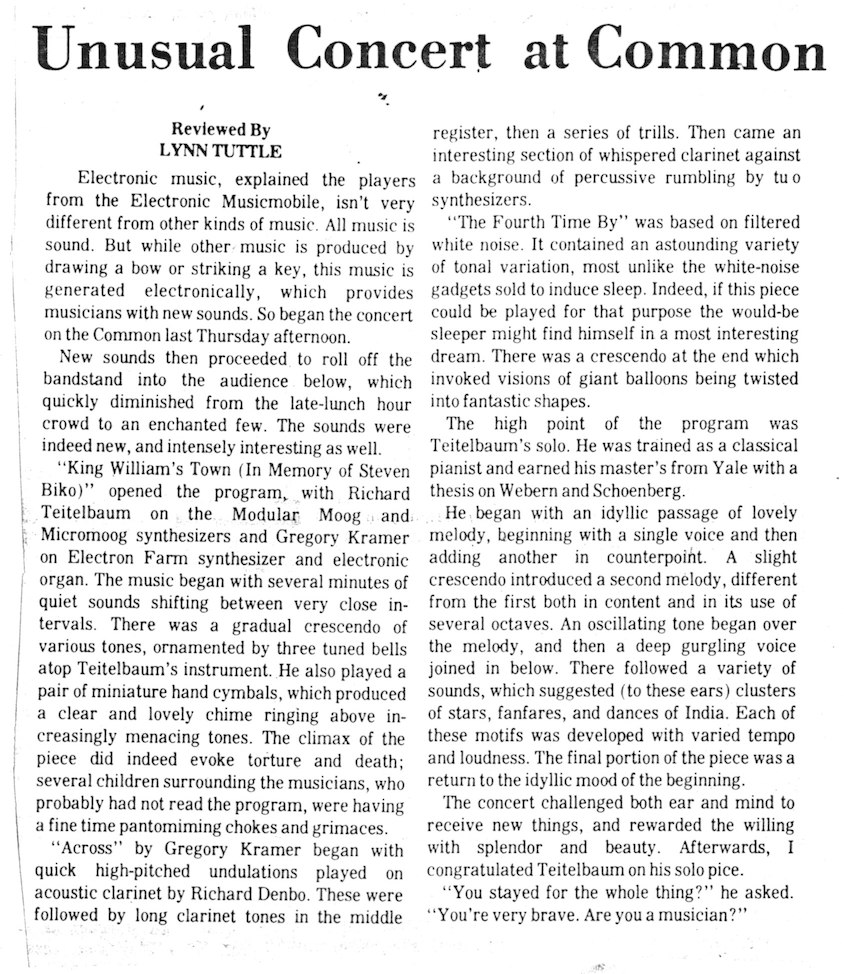
During our interview, I could sense in Greg’s nostalgic yet grounded tone that he still carries the weight of the dedication he held during his younger years as an artist — a dedication to experimentation and art for art’s sake. This was, and still is, a tough way to live – a struggle for small artists that will seemingly never cease. The world will always tell an artist the art they’re making serves no purpose, and it will be a continuous battle to reinforce their own motivations.
If you look into the history of creatives who have had a more tumultuous social career, you might notice this pattern of developing a complex in an Emily Dickinson sort of way. When you spend enough time being told that your work is weird, incomprehensible, or pointless, you can start to find a certain comfort in exactly that. The weirdness becomes the point. Being misunderstood becomes part of the identity, and eventually, something to take pride in. There’s something valuable about refusing to make your work more palatable just because other people don’t understand it.
However, there’s also a point where that resistance can turn into something else — a sort of hubris in being different.
Greg was no stranger to the mocking article headlines or dwindling crowds, so perhaps a self-determined aloofness emerged…
“It was almost as if ‘if people like what you’re doing, something is wrong’”
“An arrogant attitude with a rabid dedication to experimentation. It always had to be new, it always had to be radical”
SAHER PRAKASH: Is it good that it’s hard for people to connect with it? Do you think it it should be?
GREG KRAMER: Well, at the time, I had drunk the Kool Aid of the experimental Avant-garde. That it was not explicit, but it was almost as if if people like what you’re doing, something’s wrong. You know, it’s really an arrogant attitude with a rabid dedication to experimentation. It always had to be new. It always had to be radical, and sort of like Dada. It was like the more outraged people are, the more successful you are. And-and again, I’m overstating it, but for some some people, not overstating it much, yeah. And in fact, I was even even filmed and on like you know CBS News local whatever the I don’t know if it was CBS or NBC, but one of the major news local shows you know covered electronic music mobile, and said, “Well, do you care whether or not people like your music as they film people walking away?” You know. And I said, “No, I can’t care. I have to follow where the music’s going. Okay, that sounds very noble, but there was some disconnect, some arrogance there as well, that took me many years to diminish my kind of attachment to those kinds of views. I still have some of that sort of elitism, you know, some of that avant-garde, screw you, kind of stuff. I still have some of that in me, you know. But back then, it was more.
SAHER PRAKASH: Yeah, I mean, this is still this is a sentiment that I do believe a lot of people still chase.
GREG KRAMER: Very New York.
Greg’s admission of arrogance complicates the romantic image of the avant-garde artist that we may see in some of the bigger names like John Cage (or more genre specific, “Diva of the Diode” Suzanne Ciani). Experimentation can be liberating, and it can also become an identity. But sometimes that identity turns into elitism, prioritizing exclusion in pursuit of prestige. Dangerously, elitism can crumble a creative community if left unaddressed, even if it’s useful in accumulating recognition. Still, there are all sorts of experimenters with this complex today, for better or for worse, developing new ideas practically in their sleep. Artists will continue to create new work, weirder and weirder, and its important that they do so. Without artists like Greg trying on all different types of sound, we may never have grasped the extent of what synthesizers can accomplish.
Without room for experimentation…
We might not have had the soundtrack for iconic films like “The Shining” or “Tron”, composed by iconic synthesizer composer Wendy Carlos (check out this Issue’s STARS for one of her iconic albums)!
We might not have had “Thriller” or “Billie Jean,” which experimented with both electronic and organic sounds!
We might not have had Dua Lipa, who relies on many iconic Roland synths of the 80s!
Contrary to this article’s title, experimental sound technology is never “for” only one purpose. I encourage you to go out there and find as many purposes as you can. Go to shows! Let yourself not like it. Let yourself be put off. Today we have AI, spatial audio, VR/AR, live coding, neural audio tools, and much more. Some of this stuff currently looks ridiculous, but that’s the point. If you’re one of five confused people at a show, you might just be witnessing the start of something incredible. Somewhere right now, someone is making something with a piece of technology that everyone else thinks is stupid. And maybe in 2060, people will romanticize it.
Check out some of these experimental artists
that you editors have been enjoying!

ear
ear is a folk electronic duo formed in upstate New York. Their excruciatingly soft vocals paired with complex, often harsh electronic production manifest as soothing yet grimy compositions. Their breakout single “Nerves” was recorded on an iPhone in a library!
Tala Schlossberg
Tala’s links between visual and sound are uniquely delicious. She is a New York-based artist who creates a range of work from animations to collage and sound design. She just released a visual instrument called “playmusictheory“.
EQ
Argentinian music duo EQ produces a specialized and specialized sound. Leaning into the rise of electro-pop, their high-energy dance music is perfect for a hazy night out. Check out 7’Mix, which references a range of iconic digital drums.
Vesta Weed
New York-based illustrator, photographer, and designer Vesta Weed creates diverse and surreal work that leans into raw imagery, collage, and childlike distortion. This article’s feature image is a frame from her cartoon series “Morg and Snorf,” which depicts a personified keyboard and guitar that dream of making it big in music! Check out Vesta’s work for some whimsy.
Check out some of the more recent work from
Greg’s group, Electronic Arts Ensemble!

“Hudson” off inquietude
LISTEN HERE This track displays the slow build and inconsistencies of the semi-structured live studio recording that it is — moments of extreme dissonance into bursts of euphoric consonance.
“Sentences (With Interruptions)” off inquietude
LISTEN HERE Cartoonish and sporadic, this track evokes all of whimsy, confusion, and nostalgia. A cacophony of spatial sound, it forces your attention. Listen with joy.
“Haiku” off Return
LISTEN HERE This track is short and sweet, much like its poetic counterpart. It beckons a comfortable, glowing visual.