FIELDWORKS and the living archive of Harvestworks
BY SAHER PRAKASH & STEPHANIE FARMER
FIELDWORKS is here to give you an on-the-ground experience – a guided exploration of Harvestworks’ experimental niche. In the garden bloomed from Harvestworks’ mission, FIELDWORKS surveys and connects the large archive of work with the present of experimentation. As we publish Issues, each story will be rooted in the people who hold technology in their hands.
Warm wood floors creak upon entering the SOHO studio; almost sacred historical ground, contrasting the big box stores that line Broadway now. We invite you into the warmth to witness the shelves of tapes and programs, “obsolete” technologies, collaborative labor, and decades of media experimentation that continue to inform contemporary artistic practice.
at an event celebrating 50 years of Harvestworks
Audio captured by e-flux 5/9/2026
Harvestworks manifests as a pipeline and production laboratory to fuel artists exploring technologies. Having supported over 14,000 artists, there is a wide breadth of history, and much more to come. FIELDWORKS is here to weed through the roots of such innovation, and in the age of technological extremism, prove that technology’s history is human history.
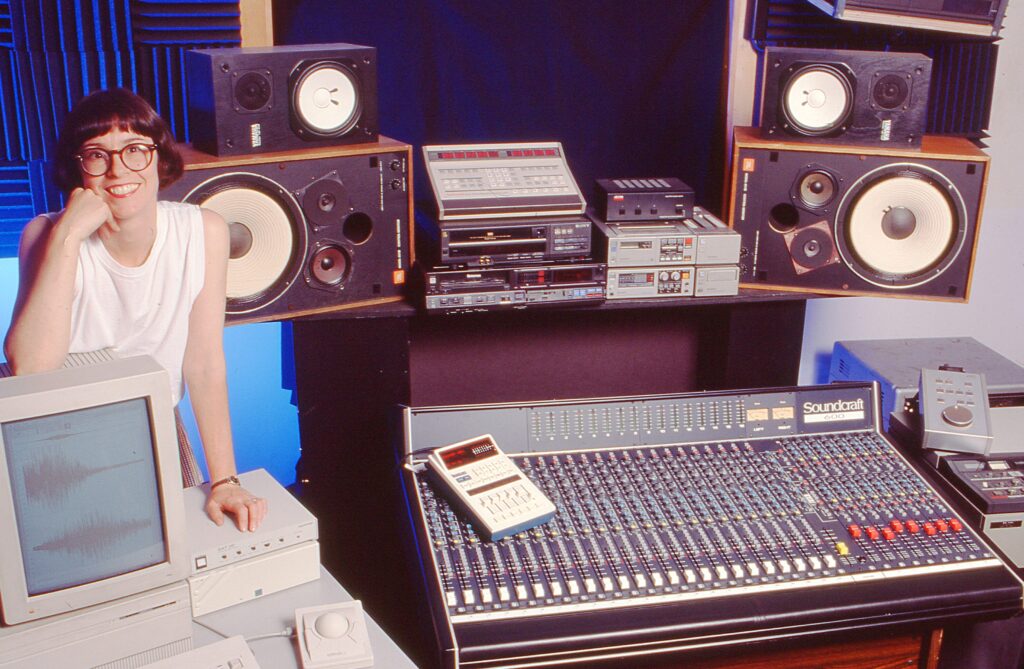
We want to highlight Harvestworks’ collectivist infrastructure as an art, prioritizing a community of ideas over individual success. Founded by Gerald Lindahl and Gregory Kramer in 1976, the organization was designed to sow many artistic projects, and harvest the innovation from each of them – hence the name. Former director Carol Parkinson carried the torch for 37 years, nurturing Harvestworks’ community of artists and providing profound support as they explored technology at its fulcrum of generative potential.
From FIELDWORKS, you can expect a multimedia journalistic approach that reflects Harvestworks’ artistic range. Drawing from the extensive archives, we treat documentation and preservation as creative acts in themselves. With our feet on the ground, we will dig, discover, and disseminate.
Harvestworks’ structures are malleable and shifting, essential traits for creativity, and the FIELDWORKS format will follow suit. Within each monthly Issue, you’ll find an interconnected implementation of video, audio, photography, graphics, and writing depending on the subject. The journal’s versatility is designed to ensure that stories are accessible without flattening their experimental complexity. Each Issue will feature 3 invitations….
Follow the roots to uncover something older – a story forged from the archives.
Follow the stream to experience something current – a story unfolding in real time.
Follow the stars to investigate a new light – a monthly collection of uncoverings from the greater art world.
FIELDWORKS is named for our methods of research. Farmers in our own right, we are in the field watching incredible work grow from the studio and its patrons. We will be on location, tending to wherever we must in New York City’s expansive collaborative arts scene connected to Harvestworks. With our feet on the ground, we will harvest naturally and appropriately for the environment.
“There is a technological sea change going on right now, but the values of the organization are still deeply connected to individual expression.” – Carol Parkinson @ Issuu Project Room
As a journal rooted in technology and innovation, we cannot ignore the emergence of generative Artificial Intelligence and its snowballing implications. Like many technologies that have passed through Harvestworks, AI requires both experimentation and critical inquiry. We encourage you to look critically at our organization’s history of innovation, as well as AI more generally, and to consider how humans and technology continually shape each other.

Technology inspires us to form creative media like this journal, to experiment indefinitely, and to support artists. Technology also confuses, distracts, and harms. We must sort through this multiplicity and try to pull the right threads from it, just as we’ll be sorting through the inner workings of Harvestworks and its development. Remember, technological history is human history.
People are at the forefront of every story, as we build a human-centered documentation of technology and art. Following in the footsteps of influential Harvestworks initiatives like TELLUS and StudioPass, FIELDWORKS is just a seedling sprouting from a monumental collective. Each Issue will inspire rabbit hole journeys, inviting readers to follow unexpected connections.
As Harvestworks just celebrated its 50th birthday, there is much to record and discover! In tandem with the launch of this new website, FIELDWORKS ushers in an era of abundance and celebration, making the organization’s past, present, and future discoverable.
By following its roots, streams, and stars, we hope each Issue opens a new path into the people, ideas, culture, and technologies that have made Harvestworks what it is – and what it might become.
Start your journey by exploring the first edition of ROOTS and STARS!
Postface: Preview of Interview with Greg Kramer
From co-editor Saher Prakash
I had the incredible opportunity to sit down for a long conversation with Greg Kramer, one of the co-founders of Harvestworks. He’s lived on a beautiful island in the Pacific Northwest since leaving New York, and as we talked, I could hear the years of creativity and contemplation behind his voice.
Early in our conversation, he touched on something that feels important to acknowledge on a platform like FIELDWORKS, which invites readers into a niche that can often seem impenetrable:
Experimental sound art and music can be inaccessible. It can feel gatekept, pretentious, elitist, or simply out of touch.
Greg explicitly expressed this, but also provided a reframing: everyone in this field is, first and foremost, an inventor. The impulse to experiment is what makes the work so compelling, but that impulse can sometimes be intertwined with a kind of sociological detachment. Innovation and alienation have, at times, grown side by side.
I wanted to include this excerpt almost as a disclaimer, but more importantly, as an invitation. If you’ve found sound art or digital media experimentation confusing, frustrating, or even distasteful, you’re not alone. FIELDWORKS exists to offer a way in. We hope to provide context for the strange and inventive work Harvestworks fosters. It might be jarring. It might rub you the wrong way. It might completely reshape the way you experience the world around you.
My only advice is this: try to connect with the work but don’t force it. Not everything has to resonate immediately or at all.
The full conversation with Greg will be published as a feature in Issue 2. For now, I wanted to share one particularly honest and articulate moment from our discussion.
Take a listen, and welcome to the world of inventors.
Let’s explore together,
Saher
Further resources!
Explore the names mentioned in this feature….
Carol Parkinson, Ivana Dama, e-flux, John Cage, Mike Kelley, Pauline Oliveros, Zeena Parkins, Gerald Lindahl, Gregory Kramer