1989 Artists in Residence
Awarded Artists:
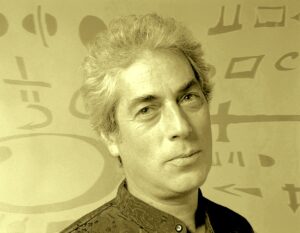
David Simons
David Simons composes music for theater, dance, film, installations, and concert ensembles. His unusual collection of sounds from self-built and non-European instruments combines with digital sampling technologies to create a unique pan-cultural music. He has devised his own method of using the Theremin as a Midi controller. David has researched and performed music from many of the world’s cultures, and furthered his music studies in Bali, Bangkok and Seoul. As a founding member of the FUTURE PRIMITIVE ENSEMBLE his pieces were heard live on radio and in concert throughout the U.S. He has also performed on tour in Java, Bali, Korea, Japan, Eastern and Western Europe, Canada, Cuba and Hawaii.

Myra Melford
Myra Melford (Music) for the development of the live interactive music performance system to use with My Face of Us All, a full length multi-media work with choreographer Dawn Saito and architect Michael Haberz. This work was first workshopped in Graz, Austria in the fall of 2000 as part of the Sytrian Autumn Arts Festival. Myra is a composer currently living in Brooklyn, NY.
Scott Alburger
“Whistling and Working”
An interdisciplinary project for video, music and 9 performers, which examines the cultural assumptions about the difference between business and pleasure. Scheduled performances include the International House and the Community Education Center in Philadelphia and the Headlands Center for the Arts in San Francisco.
Alexander Hahn
“Dirt Site”
An abstract/poetic video work that explores dreams, present-day mythology and metaphysics. Partial funding for this project has been received from the New York State Council on the Arts.
Christopher Hart
“Ange Passe”
A collaboration with Steve Factor (text) and the David Dorfman Dance Company. Loosely based on a hypothetical mixture of James Agee’s novel “A Death in the Family” and the history of Lizzie Borden. The work will premier at the Dance Theater Workshop in NYC.
Su-Chen Hung
“On the Way Home”
An installation for multiple-screen video, sound, slides and reflective pool. Based on a train trip in Taiwan, the work incorporates an audio loop of sounds recorded at each station. This work will be included in the Film Arts Festival sponsored by the San Francisco Film Arts Foundation.
Kevin Jones
“Imaginary Portrait #1
A work for radio based on recordings of vocalist Jill Burton. Sounds from the smallest vocal utterance to full-voiced multi-tracked singing will be combined with various spatial settings to create an imaginary vocal portrait. To be broadcast on WNYC in the fall of 1989.
Bun-Chin Lam
“EO-9066”, a score for Bay area choreographer June Watanabe. The score, for vocalists and tape, will be a collage of various vocal behaviors such as whispering, talking, yelling, and singing. Performances are scheduled for the Theater Artaud in San Francisco and the Japan Society in NYC.
Christian Marclay
“A Radio Play”
A surreal narrative structure of LPs of opera, pop, spoken words, and poetry. Commissioned by the New American Radio Series for broadcast in 1990.
Anna Rubin
“Father/Daughter”
A semi-autobiographical work that focuses on purely abstract and figurative (textural/communicative) sound. Performances of this work are scheduled at the Alternative Museum (NYC) and in Germany, Holland, and Belgium.
Arleen Schloss
“Eat Your Words (Letter by Letter)”
A video study of language, semantics and the absurdity of communication with words. The soundtrack will use live sound, music, sound effects and narration. It will be presented at the Kitchen (NYC).
Richard Teitelbaum
“Golem Songs”
A new work for acoustic instruments and interactive electronics. The piece will premier at the Jewish Museum in March 1989.
Robert Ziebell
Score for “This State I’m IN”
An experimental narrative film, in which three composers will write a musical structure, inspired by sound effects and samples taken from the Texas coast, for each of the three narrators involved in telling the story of a young girl in search of her identity.
Nancy Laird Chance
Film score composer and recent composer/fellow at the Sundance Institute, Chance seeks to acquire a knowledge of computer music systems and the techniques required to produce these sounds and sync them to film or video.
David Clary
An audio work for a multi-channel site piece designed for pedestrians. The artist will also work on developing a flexible software program for exterior soundscapes.
Michael Gordon
The application of MIDI technology to live orchestral work.
Bill Obrecht
The use of sound sample programs on computer for use in real-time performance.
Matthew Schlanger
Schlanger’s video work to date has been produced using a hybrid of analog and digital processing. Using analog synthesis as a model, video segments are real-time structures where sound and image tracks are produced simultaneously. He will be exploring the possibilities of assimilating MIDI techniques into his work.
David Simons
Instrument maker, collector, and adapter, Simon will create samples of many of these sounds for flexibility of use in live performance.Instrument maker, collector, and adapter, Simon will create samples of many of these sounds for flexibility of use in live performance.