2012 Sponsored Projects
Awarded Artists:

Mari Kimura
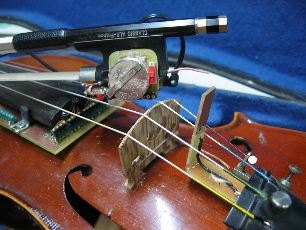
Mari Kimura, hailed by The New York Times as a “virtuoso playing at the edge,” is a visionary violinist, composer, and educator renowned for merging technology with music. She pioneered “subharmonics,” a groundbreaking bowing technique that extends the violin’s range below its lowest string. A Guggenheim Fellow, she has received the Fromm Commission, a residency at IRCAM, and was honored by the Carnegie Corporation as an ‘Immigrant: Pride of America,’ she is only the second Japanese national to receive this recognition, following Yoko Ono. In 2020, Kimura launched MUGIC®, a wireless motion sensor revolutionizing artistic expression, now used at leading institutions such as Harvard, UC Berkeley, Juilliard, and professional venues such as the Osaka Expo 2025, the Lincoln Center, and the Venice Biennale. Her innovation and entrepreneurial efforts earned her a Certificate of Congressional Recognition from the U.S. House of Representatives. A professor at UC Irvine and longtime Juilliard faculty member, she continues to push musical boundaries through composition and improvisation. In 2025, she was honored with the SEAMUS Award for lifetime achievement in electroacoustic music.
Associated project: One

Hans Tammen
Hans Tammen is just another worker in rhythms, frequencies and intensities. He likes to set sounds in motion, and then sit back to watch the movements unfold. Using textures, timbre and dynamics as primary elements, his music is continuously shifting, with different layers floating into the foreground while others disappear. This flows like clockwork, “transforming a sequence of instrumental gestures into a wide territory of semi-hostile discontinuity; percussive, droning, intricately colorful, or simply blowing your socks off” (Touching Extremes).

Associated project: Apheresis
Kathy Brew
Associated project: Beauty Behind Bars
Roberto Guerra
Associated project: Beauty Behind Bars
Marie Sester
Marie Sester is a French-American artist working primarily with digital technologies to create works in a variety of media and formats, most often presenting responsive media. Born in France, Marie Sester began her career as an architect after earning a Master’s Degree from the Ecole d’Architecture in Strasbourg, France. Her interests soon shifted from designing physical structures to the study of ideological ones, and of how culture, politics and technology affect our spatial awareness, our emotions and behavior.
After traveling extensively she moved to the U.S. in 2000. Marie Sester received a Creative Capital Grant in 2002. Her installations and websites earned an Honorary Mention in Interactive Art from Ars Electronica (2003), a Webby Award for Net Art (2004) and a spot on the “50 Coolest Websites” list on Time Magazine Online (2004).