2015 Sponsored Projects
Awarded Artists:
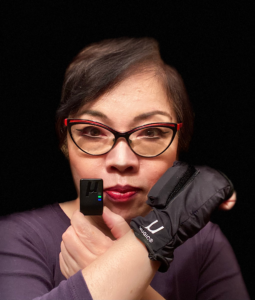
Mari Kimura
Mari Kimura, hailed by The New York Times as a “virtuoso playing at the edge,” is a visionary violinist, composer, and educator renowned for merging technology with music. She pioneered “subharmonics,” a groundbreaking bowing technique that extends the violin’s range below its lowest string. A Guggenheim Fellow, she has received the Fromm Commission, a residency at IRCAM, and was honored by the Carnegie Corporation as an ‘Immigrant: Pride of America,’ she is only the second Japanese national to receive this recognition, following Yoko Ono. In 2020, Kimura launched MUGIC®, a wireless motion sensor revolutionizing artistic expression, now used at leading institutions such as Harvard, UC Berkeley, Juilliard, and professional venues such as the Osaka Expo 2025, the Lincoln Center, and the Venice Biennale. Her innovation and entrepreneurial efforts earned her a Certificate of Congressional Recognition from the U.S. House of Representatives. A professor at UC Irvine and longtime Juilliard faculty member, she continues to push musical boundaries through composition and improvisation. In 2025, she was honored with the SEAMUS Award for lifetime achievement in electroacoustic music.
Associated project: Voice-MO
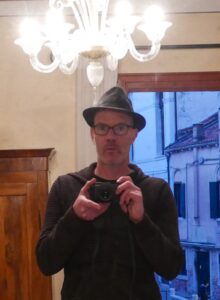
Shaun Irons
Throughout his career, Shaun Irons has engaged a provocative synthesis of video, film, audio and sculptural objects to create multidisciplinary performances, multimedia installations, experimental films, documentaries and interactive video scores to accompany live performance. Irons does not make distinctions between these forms but sees them as deeply interconnected and equally part of his ongoing artistic output.In addition to media work, Irons maintain a daily, ritualistic practice of drawing and photography.
Associated project: Standing By: Gatz Backstage

Christina Campanella
CHRISTINA CAMPANELLA (Composer, Sound Artist) works with music and sound across artistic disciplines. Her pieces for theater, film, concert and installation have been shown throughout the U.S. and Europe (EMPAC, Museum at MIT, HERE, Harvestworks/NY Electronic Art Festival, Fylkingen, Stockholm, Simultan, Romania, and Noorderzon, the Netherlands), including Red Fly/Blue Bottle (co-created with writer Stephanie Fleischmann). She has also been an actor/vocalist in downtown theater and independent film since 1998, played keyboards with various New York bands, and is a frequent collaborator of composer/sound artist Joe Diebes (WOW, botch, i/o). In 2018, Christina will perform in Diebes’ opera oyster at Roulette in Brooklyn. She is a recipient of three NYSCA Individual Artist Commissions in Film, Media, and New Technologies and support from LMCC, Mid-Atlantic Arts, American Music Center, Whitman College and NYS Music Fund. Website: http://xtinasworld.com
Associated project: I WENT TO THE LIGHTHOUSE (AND IT WASN’T THERE)
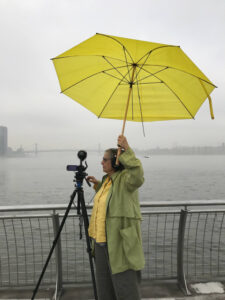
Liz Phillips
Queens-based artist Liz Phillips has been making interactive multimedia installations for the past 50 years, which combine audio and visual forms with new technologies to create an interactive experience. Phillips has exhibited interactive installations at numerous art museums, alternative spaces, festivals, and public spaces. These include multiple installations at the Queens Museum, The Whitney Museum of American Art, Lincoln Center, The Milwaukee Art Museum, the Spoleto Festival USA, the Walker Art Museum, Ars Electronica, The Kitchen, and Creative Time.

Associated project: Wave Crossings
((audience))
((audience)) is dedicated to the advancement of aural arts by providing wide distribution and new contexts for works by emerging and established sound artists and composers.
Associated project: Sound Off Concert Series
Phillip Stearns

Associated project: Open Hardware HD Video Synthesizer
Sandra Binion
Sandra Binion is an interdisciplinary artist with training in classical ballet as well as fine arts. Binion began incorporating film and video into her performance pieces in the early 1980’s and soon decided to pursue an MFA in filmmaking from from the School of the Art Institute of Chicago in 1992. Binion’s work has since underwent a further expansion in the early 2000s beginning a serious practice of painting and digital photography. Binion’s photographic work often focuses on details of surface, light, architecture and bodies—crystallizing, in a sense, the ongoing interests in site, space, gesture, and the choreography of the everyday. At present, video, photography, and painting have now become synergistic elements in multi-disciplinary thematic projects intended for exhibition.

Associated project: DISTILLÉ

Sergio Krakowski
Born on December 18th 1979, Krakowski has dedicated his whole life to the Pandeiro, also known as the Brazilian Tambourine. A complete “hand drum kit”, this instrument has always been considered a symbol of Brazilian Music and Culture. Crossing whatever national and cultural barrier, Krakowski made this instrument a possible tool in various musical genres, from the Choro, the fundament of Brazilian Music, to Jazz, Contemporary and Electronic Music.