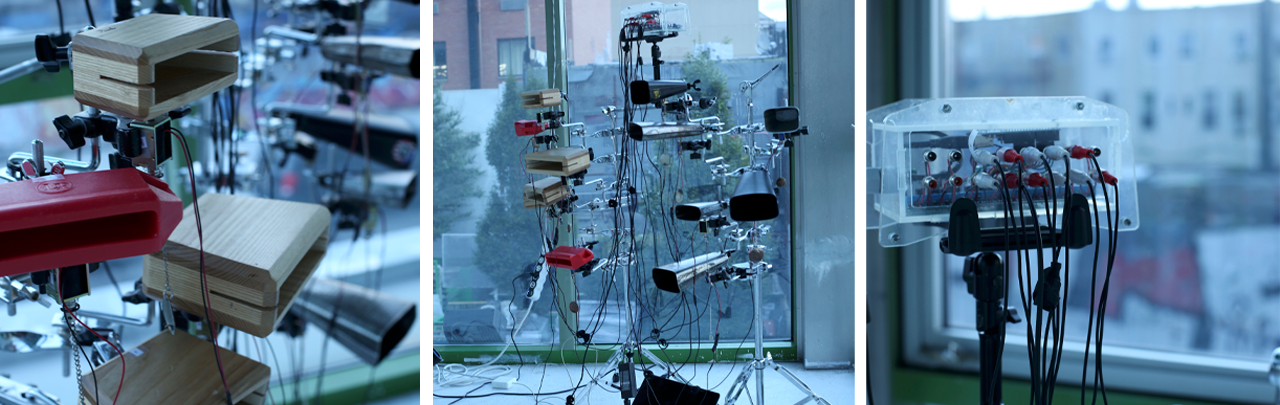

Rhythmic music software is usually based on the Euclidean plane; as in Western music notation, there is a single grid in which time flows from left to right and there is only one metronome/clock that works as a “conductor”. On the other hand, the “brain” of this robotic sculpture is a software the artist coded, which has 8 independent clocks and grids that are constantly moving. It is as if instead of having a single conductor, there are 8 “percussionists” improvising simultaneously, as in Latin American rhythmic logic, which has the goal of making people dance.
It is not that common in Latin American rhythmic improvisation to see the use of danceable rhythms such as salsa, in the world of experimental music or new technologies. And vice versa: it is infrequent to see the use of generative robotics in the world of salsa.
This project is part of the series “Myth and Prosthesis”. “Myth” being the cultural ideals that inform the creation of technology. Prostheses are the merging of bodies with technology. Are all cultures represented in the development of technology? Can we use technology beyond the personal data mining model? The answer is not to reject technology but to create one that helps us expand our bodies and minds.