2024 Artist Scholarship and Workspace Recipients
Awarded Artists:
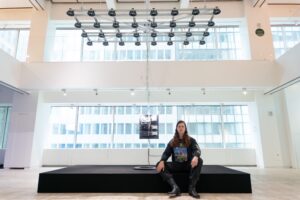
Emmett Palaima
Emmett Palaima is an artist working with electronics and esoteric processes of sound creation. His work is conceptually rooted in the idea that technology and magic are one and the same, and that electricity is a manifestation of the divine or elemental forces underlying physical reality. He creates instruments which explore the experience of sound as an embodied, physical process and the sculptural beauty of the systems used in sound creation.
His practice approaches music history through a materialist lens: that the technological tools used to make music drive its stylistic development, and that by building new platforms for sonic experience, it is possible to advance the music-historical process. A key feature of this approach is collaboration, making the instruments he creates accessible to other performers thereby sharing and more fully exploring their sonic and creative potential. This approach centers on a long-term body of work building towards the creation of TEMPLE-65536: the world’s largest spatial audio instrument as a permanent installation open to artists and composers from around the world.
He has been an artist-in-residence at Harvestworks and a recipient of a NYSCA Support for Artists Grant. In 2024, he opened Chambers Hum, a public sound artwork developed in collaboration with the NYC MTA, active seven days a week on the Chambers St A/C subway platform. His work has been exhibited internationally, including at the Currents New Media Festival and Fusebox Festival. He has worked as a Sound Technologist for immersive installations with Meow Wolf Creative Studios and Dadalab, and contributed to projects for the Whitney Biennial, the Palm Springs Art Museum, and the CalArts MTIID Program. He has toured as a guitarist with Elizabeth Colour Wheel and played electronic ensemble sets at Moogfest and MASS MoCA. He has also worked professionally as a designer of guitar pedals and synthesizers. His practice is a consolidation of these diverse influences, combiningelements of functional and aesthetic design, sound, performance and architectural space. He lives in New York City.

Katherine Liberovskaya
Katherine Liberovskaya is an inter-media artist based in New York City and Montreal, Canada. Involved in experimental video since the 80s, she has produced many single-channel videos, video installation works and video and music performances which have been presented at a wide variety of events and venues around the world.
Tom Bloxam
Tom Bloxam is a sound artist based in Brooklyn, NY. His work, which includes spatial audio practices, found-sound collages, and vinyl DJing, explores the nature of the relationship between sound and environment. He will be developing an immersive, stimulus-based sound installation.

Casey Tang
Casy Tang is an artist and researcher whose work explores the intersections of ecology, narrative, and sound. Casey will be developing his project To Carry the Earth, which sonifies the possibilities of embracing a geocentric worldview, instead of the typical Western egocentric frame of reference. Casey’s work has been shown internationally in China, Japan, Germany, and across the US.
Xenobia Bailey
Xenobia Bailey is an artist, designer and activist based between Philadelphia, PA and New York, NY. Her crochet work has appeared in Elle Magazine, Do the Right Thing (1989), among other places. She is now experimenting with digital photo narratives and video work. Xenobia is developing a body of work includes historical research at the Historical Society of Pennsylvania on The Free Blacks Community in 1700s Philadelphia, and at the Schomburg Center for Research in Black Culture in New York.
The Daxophone Consort
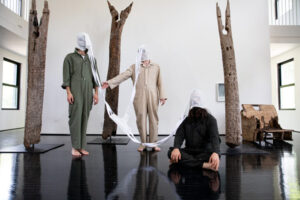
The Daxophone Consort is Daniel Fishkin, Cleek Schrey, and Ron Shalom. The daxophone is a thin wooden strip played with a bow, which was created by the German improviser/inventor Hans Reichel in 1987. The instrument’s sound, somewhere between a cello and badger, ranges from furtive gurgles and delicate whistles to wild screams. The Consort has been active since 2015. They develop realizations of historical experimental music and baroque motets, commission new daxophone pieces from living composers, and generate new pieces based on shared improvisational grammar. At Harvestworks, The Consort will reimagine, record, and perform composer John Cage’s 1979 choral work, Hymns & Variations.